NAD+ and NMN: What They Are and Whether the Supplements Actually Work
NAD+ is a coenzyme central to mitochondrial energy production and DNA repair that declines by roughly 50% between your 20s and 50s -- and restoring it through NMN supplements or IV therapy is one of the most talked-about interventions in longevity medicine. Dr. Farhan Abdullah explains the biology clearly, distinguishes oral NMN supplements from IV NAD+ therapy, reviews where the human evidence actually stands (promising but not yet definitive), and describes how NAD+ fits into the longevity medicine program at Magnolia Functional Wellness in Southlake. If you've seen NAD+ trending and want a physician's honest take, start here.
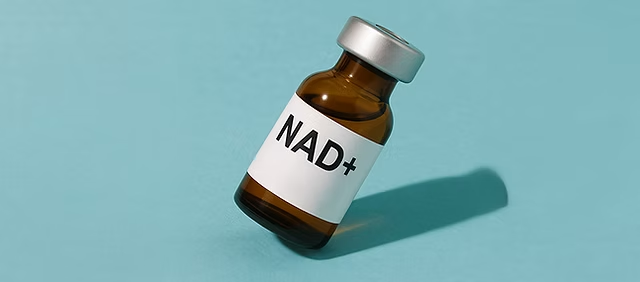


If you've spent any time in longevity circles -- or just watched a few Andrew Huberman podcasts -- you've heard about NAD+. It's being called everything from the "molecule of youth" to a fundamental key to reversing aging. David Sinclair at Harvard has spent years making the case that restoring NAD+ levels could be one of the most powerful anti-aging interventions available. Supplements like NMN and NR are selling in massive volumes. So what's actually true here, and what's hype?
I'm Dr. Farhan Abdullah, and I offer NAD+ IV therapy in Southlake at Magnolia Functional Wellness. I have a strong personal and clinical interest in this space, which is exactly why I want to give you an honest assessment rather than a sales pitch.
What NAD+ Actually Is
NAD+ stands for nicotinamide adenine dinucleotide. It's a coenzyme found in every living cell in your body and it's involved in hundreds of metabolic processes. Its most fundamental role is in the electron transport chain -- the process by which your mitochondria convert nutrients into ATP, the energy currency your cells run on. Without adequate NAD+, energy production becomes inefficient at the cellular level.
But NAD+ does more than power mitochondria. It's also a critical substrate for two classes of proteins that are central to aging biology: sirtuins, which regulate DNA repair, inflammation, and gene expression; and PARPs, which repair DNA damage. Both sirtuins and PARPs consume NAD+ when they're active. As we age and encounter more cellular stress, these repair systems ramp up their NAD+ consumption -- but NAD+ production simultaneously declines with age. The result is a progressive depletion that impairs the very repair mechanisms your body depends on.
By the time you're in your 50s, NAD+ levels may be roughly half what they were in your 20s. By your 60s and 70s, the decline is even more pronounced. This isn't speculation -- it's been measured directly in human tissue studies.
NMN vs. NR: The Precursor Debate
Here's where the supplement conversation gets more nuanced. You can't just swallow NAD+ and have it work -- the molecule is too large to enter cells directly. Instead, supplements use precursors that your body converts into NAD+. The two most popular are NMN (nicotinamide mononucleotide) and NR (nicotinamide riboside).
NMN is one step closer to NAD+ in the biosynthesis pathway. NR is one step further back. Both have shown the ability to raise blood NAD+ levels in human studies. The question that's harder to answer is whether raising blood NAD+ levels translates meaningfully into raising tissue NAD+ levels -- particularly in the brain, heart, and skeletal muscle where it matters most.
The honest answer is that the human data is promising but not yet definitive. Animal studies, particularly in mice, show impressive results: improved mitochondrial function, better energy metabolism, enhanced DNA repair, protection against age-related decline. Human studies are smaller, shorter, and less dramatic -- but they do consistently show that oral NMN and NR raise blood NAD+ levels, and several trials have found improvements in muscle function, insulin sensitivity, and physical performance in older adults.
Why IV NAD+ Is Different from Oral Supplements
This is the most important distinction I can make for anyone considering NAD+ therapy. Oral NMN supplements are a very different intervention than intravenous NAD+.
With oral supplements, you're relying on gut absorption and conversion pathways that vary significantly between individuals. Bioavailability is meaningful but incomplete. Blood levels rise, but how much reaches specific tissues is harder to control.
IV NAD+ delivers the molecule directly into the bloodstream in concentrations that would be impossible to achieve orally. It bypasses gut absorption entirely, produces immediate and measurable increases in circulating NAD+, and the clinical effects reported by patients -- dramatically improved energy, mental clarity, mood stabilization, and relief from withdrawal symptoms in addiction contexts -- tend to be more pronounced and faster-acting than anything seen with oral supplementation.
Our NAD+ IV therapy program in Southlake is used for several indications: cognitive support and mental clarity, energy and mitochondrial optimization, recovery support, and as part of our broader longevity medicine approach. The experience during infusion can be intense -- some people feel a chest tightness or sense of urgency that passes quickly -- which is why it's done in a supervised clinical setting, not at home.
What the Longevity Research Actually Shows in Humans
Let me be straight about where the evidence stands. The most compelling NAD+ data is in animal models. Mice given NMN or NR show remarkable preservation of energy metabolism, muscle function, vascular health, and even lifespan extension in some studies. The problem is that mice are not humans, and several therapies that extended mouse lifespan haven't translated to humans.
Human trials for NAD+ precursors are growing in number and quality. A clinical trial at Washington University in St. Louis found that NMN supplementation improved muscle insulin sensitivity and physical performance in postmenopausal women with prediabetes -- a meaningful finding for a population at high metabolic risk. Other trials have shown improvements in cardiovascular markers and physical function in older adults.
The evidence isn't yet at the level where I'd call NAD+ supplementation definitively proven for human longevity. But the biological rationale is sound, the safety profile is excellent, and the early human data is encouraging enough that I consider it a reasonable component of a comprehensive longevity strategy -- particularly for people over 40 where the age-related NAD+ decline is becoming clinically meaningful.
Practical Considerations
If you're considering oral NMN or NR supplements, 500mg daily is the dose used in most positive human trials. Quality varies significantly between brands -- look for third-party tested products. Liposomal formulations may improve bioavailability. Take it in the morning since NAD+ metabolism is tied to circadian rhythms.
If you're interested in IV NAD+, understand that it's a time investment -- infusions typically run 2 to 4 hours depending on the dose and protocol. Some people do a series of infusions over several days for an initial loading effect, followed by periodic maintenance. The effects people describe -- particularly the cognitive clarity and energy -- are real and often dramatic, but individual response varies.
NAD+ works best in the context of the other things that support mitochondrial health: adequate sleep, resistance training, minimizing alcohol, managing metabolic syndrome. The molecule can't compensate for a lifestyle that's actively destroying mitochondria. But for someone doing the fundamentals reasonably well and looking to optimize further, it's one of the more evidence-informed options available.
Your Questions Answered
Led by trained medical professionals delivering safe, effective, and scientifically backed aesthetic and wellness treatments.
Why Does NAD Take Longer Than Other IVs?
NAD+ stimulates cells rapidly. To prevent an uncomfortable sensation known as a 'flush' or nausea, we must drip it slowly over 2–4 hours. This slow pace is a sign of a high-quality, high-dose treatment.
Is NAD+ IV different from oral NMN or NR?
Yes, meaningfully so. Oral NMN and NR are NAD+ precursors that need to be absorbed, converted, and transported intracellularly. They do raise blood NAD+ levels and have human trial evidence, but their bioavailability varies individually and GI absorption limits the achievable dose. IV NAD+ delivers the coenzyme directly into the bloodstream at higher concentrations than oral routes can achieve. Both approaches have a role; they're not interchangeable.
What is NAD+ Therapy and how does it work?
NAD+ Therapy at Magnolia Functional Wellness is cellular-level support for energy, cognition, and longevity pathways.. This treatment works by [specific mechanism based on service type]. Our physician-supervised protocols ensure safe, effective delivery of this anti aging treatment, tailored to your unique needs and goals. During your consultation, our medical team will explain the specific mechanisms and expected outcomes for your personalized treatment plan.
Who is a good candidate for NAD+ Therapy?
NAD+ Therapy at Magnolia Functional Wellness may be right for you if you're seeking cellular-level support for energy, cognition, and longevity pathways.. Ideal candidates are individuals looking for physician-supervised anti aging treatment with evidence-based protocols. During your consultation at Magnolia Functional Wellness, our physician will assess your individual needs, medical history, and goals to determine if this treatment aligns with your wellness objectives. We provide personalized recommendations based on comprehensive evaluation.
Need More Information?
Our team is ready to answer your specific questions and concerns.